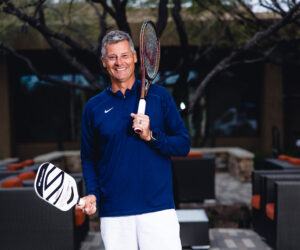

How did you get your start in tennis?
I grew up in Wichita, Kansas. At seven years old, my mom and my dad both worked and it was up to my sisters, one who was 12, the other who was 18, to look after me. I was somewhat of a mischievous kid and my sisters wanted me out of their hair. So we joined Wichita Racquet Club, which was less than a mile away. No one in my family played tennis, but I really took to it. I’d get dropped off at 8 o’clock in the morning and stay until the streetlights came on, or when it was time for dinner. Tennis became part of my DNA.
Who were your favorite tennis players in your youth?
I was a big Boris Becker fan. I remember watching him win Wimbledon, unseeded at age 17 in 1985. I liked watching Andre Agassi for his flair, even though my own style was more like Pete Sampras. I liked John McEnroe, too. He wasn’t always the nicest guy on the court, but you had to respect his genius and how he played the game. Another of my favorites was Richard Krajicek, the 1996 Wimbledon champion from Holland. We played the same kind of style, all-court player, big serve, big forehand. People said we looked a lot alike—tall guy, similar features. But in modern times, it’s Roger Federer. He was such a class act, so gracious and humble.
Describe your career path before you arrived at Desert Mountain.
I had a wonderful time at Wichita State. I loved being a (Wheat) Shocker. [Note: Slivocka was a three-time all-conference selection in singles and doubles for his nationally ranked university team. He helped his team to two conference titles and three NCAA tournament berths.] One of my coaches when I was a junior, Rex Coad, was the head coach at Wichita State. He’s always been kind of that tennis father figure to me. He directed me into teaching. He’s almost 70 now and is the Director of Racquet Sports at Wichita Country Club. He’s still a good friend of mine. My career goal was to be a director of racquet sports by the time I was 30. I got that opportunity at Tucson Country Club. I would have stayed there more than four years, but my folks had some health issues so I moved back to Kansas and took the job of Director of Racquet Sports and Fitness at Prairie Dunes Country Club.
What was the secret for elevating tennis at Prairie Dunes, and have you been able to apply any of those lessons at Desert Mountain?

With a course ranked in America’s Top 25, Prairie Dunes is known for its elite golf. You’re trying to create a culture. Prairie Dunes had that world-renowned golf course and our goal for the tennis and fitness department was to be able to create that same experience. Each golf course has its own unique identity, where a tennis court is a tennis court for the most part, but what we can do is to have our staff show how we care about the members and how we have a passion for the game. My goal at Desert Mountain was to create that family dynamic and a culture where we would be the be-all and end-all for everything the Members could want in racquets.
You moved to Mission Hills Country Club, where Super Bowl MVP Patrick Mahomes was a member. Did you interact with him?
Patrick lived about three blocks away from the club and one day, we fielded a call from his manager, asking if we could accommodate Patrick and his wife Brittany for tennis. We kept it quiet. He was the nicest guy in the world. They played for about an hour and fifteen minutes. I didn’t know what to expect, but obviously he’s a great athlete. He’s actually a very good tennis player—and so was Brittany.
What enticed you to relocate to Desert Mountain in 2022?
I wasn’t looking for a job. I was very happy at Mission Hills. But I loved the Southwest and my wife and I had always talked about getting to someplace warmer. When the opportunity came up, and Mr. DiOrio shared his vision with me, I jumped at the chance. The prestige of Desert Mountain and the standard that it sets was something that I always wanted to try. The culture here that they have for the Membership and also for the employees is something every club should aspire to.
What programs have you introduced or invigorated at Desert Mountain—and what is a highlight?
We had a lot of ladies and men’s competitions when I arrived, but no clinic and lesson programs, per se. In January 2023, we created our first lesson and clinic programs—for all levels of play. These involved weekly sign-ups, and it went very well. We introduced cardio tennis and beginners, doubles strategy and co-ed clinics. We’ve seen huge gains—a 16% increase in racquets lesson participation from 2022 to 2023 and an 11% rise in racquet lesson revenue, despite having a very wet and cold winter. It’s been great.
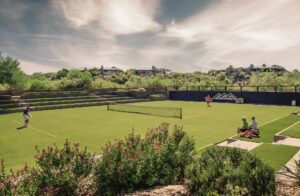

Desert Mountain serves up clay, hard and grass courts. What’s your favorite surface to play on?
My favorite to play on, not necessarily to teach on, is grass. It’s the surface I had the most success with during my tournament playing days. The grass is such a unique experience and there aren’t many grass courts in the Southwest—or clay courts, either. Desert Mountain’s grass is such a beautiful court.
For someone who wants to try the grass court for the first time, what should they expect?
The bounce of the ball is lower on grass, so you have less time to get there. Also, a backspinning slice shot is going to stay even lower and likely skid through the court. You’ll need to adjust your court positioning and hug the baseline, because the ball is not going to bounce as high as it will on a clay or hard court. Shorten your backswing and take small steps—almost like pumping the brakes—to get you hitting the ball on time.
Pickleball’s popularity continues to soar. Why?
Pickleball is a very social game. It’s more freewheeling than tennis—not so bound by traditions. It’s also a little easier to play than tennis because the court is smaller, the paddle is shorter than a tennis racquet and the ease at which to start picking up the game and playing the game right away is so appealing. Tennis is hard to play if you’ve never played it before. But I can go out and play pickleball even if I’ve never played it and I can start to enjoy it straightaway. In pickleball, players can have a wider range of skill levels and still enjoy the game. In tennis, if you get too much of a skill level difference, no one on either side enjoys it.
There’s a lot of chatter across the country about tennis players being wary of the influx of pickleball players. How do you see it?
I’m the Director of Racquet Sports, so I have two hats, my tennis hat and my pickleball hat. I’m a racquets person. I play both. I teach both. So why can’t we all live in harmony and try and help grow both sports together? We have pickleball lessons and clinics now. We’re part of the Scottsdale Interclub Pickleball League. Pickleball is here to stay. As long as everybody’s having a good time with something that helps keep us physically fit, it’s a win for everybody.
How does the skillset in pickleball differ from that in tennis?
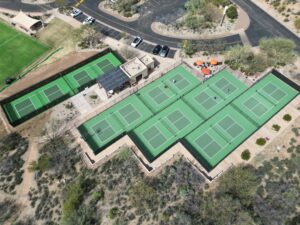

Someone who has played tennis will likely pick up pickleball faster than someone who’s never played tennis. The footwork, the eye hand coordination and the racquet/paddle skills will translate over. So does the ability to control the ball and the ability to understand angles. Pickleball relies on a much more patient game, cat and mouse. It’s a much more finesse-based game than tennis.
Injuries and pickleball seem to go hand in hand. What can players do to lower the risk of getting injured?
Pickleball players don’t always warm up properly, whether it’s stretching or light hitting before they start. A lot of times the four of them walk there and they just go. That causes a lot of quick twitch injuries, whether that’s an Achilles tendon, an ankle, a knee, whatever that might be, without warming up properly, injuries are going to rear their ugly head. Also, it’s just about knowing your limitations. If you’re getting lobbed and feel the urge to backpedal, think about it first. It’s just one point. Is it really worth losing your balance and hurting yourself for one point? As we say to the Members, the prize money is still the same whether you win or lose this match.
You’re a fan of Kansas City barbecue. What’s your favorite and have you found any quality barbecue in these parts?
My favorite Kansas City barbecue used to be called Oklahoma Joe’s. It’s in a gas station off of Mission Road and 47th Avenue, but it’s now called Joe’s Kansas City Bar-B-Que. I’ve been to all the other great places and I rate Arthur Bryant’s number 2. We haven’t really been on the lookout here, but we did try Phat Turtle near our house and it was good—pretty close to Kansas City barbecue. We received recommendations from Members for Rudy’s, and Lil Miss BBQ, so we’re eager to try those.
After all these years on the courts, what keeps you motivated?
Something I live by, is that I’m trying to get better every single day. That’s something I’ve always done, whether it’s playing competitive tennis, whether it’s playing golf, or whether it’s in my career, whether it’s in my family life—just try and get better every day. We all have failures and we all have shortcomings, but our goal is to try to overcome those as best we can.”
This story was originally written by Joe Passov, a Golf Writers Association of America (GWAA) award-winning journalist. Read the article in the Spring 2024 issue of Inside Desert Magazine.